A campaign sign has a job with a hard deadline: stay upright, readable, and intact from the day it goes in the ground until the polls close. Everything about how it is built either helps it reach that deadline or works against it. The design and the placement rules get most of the attention, but the physical specification, the material, the thickness, the way the panel meets the stake, is what actually determines whether a sign is still standing after a month of wind and rain.
The standard build, and why it is the standard
The default political yard sign is 18 by 24 inches, printed on 4-millimeter corrugated plastic, the material most people call coroplast. That combination is not an accident. Eighteen by twenty-four is large enough to read a name from a passing car yet small enough to sit within most local sign ordinances and ship cheaply in volume. Four-millimeter corrugated plastic, about 0.16 inches thick, is rigid enough to stand on a wire stake without flopping but light enough that a volunteer can carry a hundred of them. Corrugated plastic is also weatherproof in a way cardboard is not, shrugging off rain that would turn a poly-coated paperboard sign to mush within weeks. Because the flutes are hollow, the panel also stays light enough to mail flat and cheap to store, which matters when a campaign is ordering signs by the hundred and warehousing them until distribution day.
Sizes do range well beyond the standard, from small 12-by-18 hand signs up to 24-by-36 and larger panels for intersections, and corrugated plastic can be cut anywhere from a few inches to roughly 48 by 96. But the further you get from 18 by 24, the more you pay per sign and the more carefully you have to check local size limits before you print.
Flutes and stakes: the detail that quietly ruins signs
Corrugated plastic has hollow channels, called flutes, running through its core, and their direction matters more than almost anything else on the spec sheet. For a sign that mounts on a wire H-stake, the flutes must run vertically, so the two legs of the stake slide up inside the channels and hold the panel firmly. Order a panel with horizontal flutes and the stake has nothing to grip; the sign wobbles and pulls loose in the first strong wind.
This becomes a real trap at large sizes. Many printers can only produce panels wider than about 48 inches with the flutes running horizontally, which means those oversized signs are no longer stake-compatible and need a different mounting method entirely. The stakes themselves come in a couple of common heights, typically around a 10-inch-wide wire in a 15-inch or 30-inch leg length; the taller stake buys stability in soft ground and against wind, which is worth specifying for exposed roadside placements.
One side or two
Whether to print one face or both is a placement decision, not just a budget one. A sign staked in a yard facing the street only needs one printed side. A sign on a median or a corner that traffic passes from both directions needs double-sided printing to work at all, and that typically adds a modest per-sign premium that shrinks per unit as quantity grows. The practical rule is to map where signs will actually stand before ordering, then split the run into single- and double-sided quantities rather than defaulting the whole order to one or the other.
Material against the calendar
Corrugated plastic is not the only option, and the right material depends on how long the sign has to survive. Poly-coated paperboard is the lowest-cost option but lasts only one to three months and warps in sustained sun. Corrugated plastic lasts one to two years outdoors. Rigid PVC board lasts two to three years at a higher price, and aluminum survives five years or more but costs the most per sign. Exact pricing depends on size, finishing and quantity, so ask for a quote.
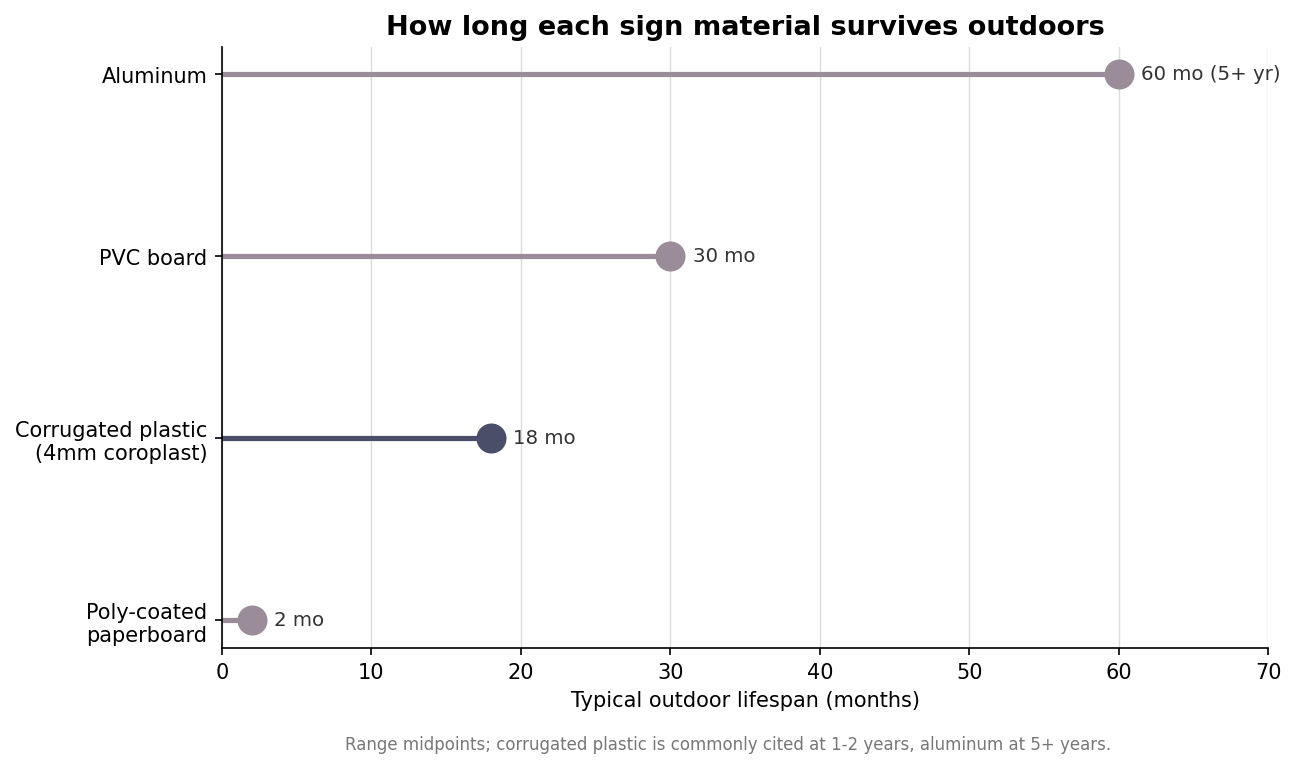
For a single election cycle, aluminum’s five-year life is wasted money and paperboard’s few months is a gamble against the weather. Weighed against the time the sign actually has to last, corrugated plastic is the value leader for anything on a campaign timeline. Aluminum only starts to make sense for signs you intend to reuse across multiple cycles or leave up permanently.
Ordering: quantity, finishing, and lead time
Two specification choices left off many orders are worth adding deliberately. Ask for UV-resistant inks on any outdoor run, because ordinary inks fade and corrugated plastic can lose its punch in strong sun long before the panel itself fails. And plan the quantity split and lead time early: printing costs drop sharply with volume, so it usually pays to order the full cycle’s signs at once rather than reordering in small batches, and standard production at Custom Political Campaign Signs is about 2 weeks after you approve your mockup, with a minimum order of 12 signs. Building that timeline back from the date signs need to be in the ground is the difference between a smooth rollout and paying for express turnaround.